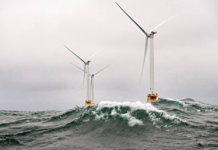

Offshore wind turbines could be sited in deeper water and closer to the shore off the U.K. coast to take advantage of stronger, more consistent wind speeds, according to the Energy Technologies Institute (ETI).
Project Deepwater, a consortium led by Blue H with BAE Systems, the Centre for the Environment, Fisheries and Aquaculture, EDF, Romax Technology Ltd., SLP Energy and PAFA Consulting Engineers, looked at the feasibility and costs of generating electricity using offshore wind turbines mounted on a floating, tension-legged platform in water between 70 meters to 300 meters deep.
‘The cost of foundations does get more expensive as you go into deeper water, but the wind speeds in much of the [deep water in the U.K.] are significantly stronger and more consistent, which results in a more reliable and higher energy output,’ says David Clarke, chief executive of ETI. ‘Over time, this more than outweighs the additional foundation costs and gives an overall lower cost of energy.’
Project Deepwater was one of the ETI's first offshore wind projects along with Nova and Helm Wind, which are due to produce final conclusions later in the year.
The Nova project is looking at the potential benefits of using an innovative vertical-axis turbine, and Helm Wind is assessing the complete design system for an offshore wind turbine array, including installation, design, aerodynamics, electrical systems, control and maintenance.
The findings from all three projects will be analyzed by the ETI before a decision is made on the next steps in the offshore wind program, which could have an offshore wind demonstrator built using technologies and insights from all three projects.
SOURCE: Energy Technologies Institute