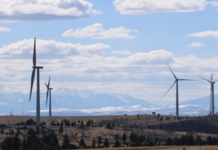

The U.S. Fish and Wildlife Service (FWS) has reopened the public comment period for the draft Habitat Conservation Plan (HCP) and environmental assessment (EA) submitted by Kaheawa Wind Power II LLC for public review. Kaheawa Wind Power II is a subsidiary of First Wind that supplies electricity to the Maui Electric Co.
Kaheawa Wind Power II developed the draft HCP in coordination with the FWS and the Hawaii Department of Land and Natural Resources as part of the application for an incidental-take permit for species protected under the Endangered Species Act.
The initial 30-day public comment period closed on Dec. 9, 2010. At the request of the general public, the comment period is being reopened for an additional 30 days.
An incidental-take permit is required when nonfederal activities are likely to result in ‘take’ of a threatened or endangered species while carrying out otherwise lawful activities.
Kaheawa Wind Power II is requesting a permit because the incidental take of four species may result from collisions during the construction and operation of a 21 MW, 14-turbine wind energy generation facility at Kaheawa Pastures. The species affected are the endangered Hawaiian goose, Hawaiian petrel, Hawaiian hoary bat and the threatened Newell's shearwater.
The HCP describes how Kaheawa Wind Power II will – to the maximum extent practicable – avoid, minimize and mitigate the potential incidental take of protected species that may result from the construction and operation the wind project.
The facility also includes an electrical substation, a battery energy storage system, an underground electrical collection system, an overhead transmission line, a meteorological monitoring tower and service access roads. The project is located within a combined area of approximately 143 acres. The permit authorizes the take of the listed species incidental to the construction, and operation and maintenance of the proposed facilities, for the next 20 years.
Kaheawa Wind Power II is proposing mitigation measures that include the following:
– active management, such as predator removal and construction of cat- and mongoose-proof fences at Hawaiian petrel and Newell's shearwater colonies;
– the release of adults and goslings at approved sites;
– habitat management and predator control to increase Hawaiian goose breeding and survival;
– surveys to document the distribution and abundance of the Hawaiian hoary bat; and
– habitat management and reforestation to benefit the recovery of the Hawaiian hoary bat.
All comments from interested parties must be received on or before March 10.
SOURCE: U.S. Fish and Wildlife Service